We specify, supply, install and maintain Camfil air filters across Ghana, for gas turbines, FPSOs, pharmaceutical plants, food and beverage factories, hotels and offices. Most jobs start with a visit to your site, because the right filter depends on what’s in your air and what you’re protecting.
What does the service include?
- Site assessment: we study your facility, air-quality goals and operating constraints on site.
- Filter specification: the right filter class and configuration for your application, referenced to ISO 16890 and EN 1822 / ISO 29463.
- Supply: genuine Camfil products, plus sourcing of matched sizes for your existing housings.
- Installation and commissioning: planned to keep disruption to your operations low.
- Maintenance contracts: preventive changes, inspections and rapid-response support.
Which filtration does each industry need?
The contaminant you are controlling decides the filter. These are the starting points we work from before assessing your site.
| Sector | Main risk | Typical approach |
|---|---|---|
| Power plants and FPSOs | Dust, salt and moisture entering the compressor | Multi-stage inlet filtration. See gas turbine filters |
| Pharmaceutical and laboratories | Particle and microbial contamination | Pre-filters and final filters with terminal HEPA H13 or H14 |
| Food and beverage | Airborne contamination of product and packaging | Fine ePM1 filters, with HEPA in the most sensitive zones |
| Hotels and offices | Fine particles, odours and stale air | ePM1 or ePM2.5 filters in air handling units, plus air cleaners |
Why does air filtration matter so much in Ghana?
Ghana’s conditions load filters heavily. A peer-reviewed study of Accra measured average PM2.5 of 89 µg/m³ during the Harmattan, against 23 µg/m³ in the rest of the year. The World Health Organization’s 24-hour guideline is 15 µg/m³.
Coastal sites add salt and humidity, which matter most for gas turbines and offshore equipment. A filter plan copied from a temperate climate is rarely right here. Our Harmattan guide explains how to adapt yours.
What is the difference between filtration and purification?
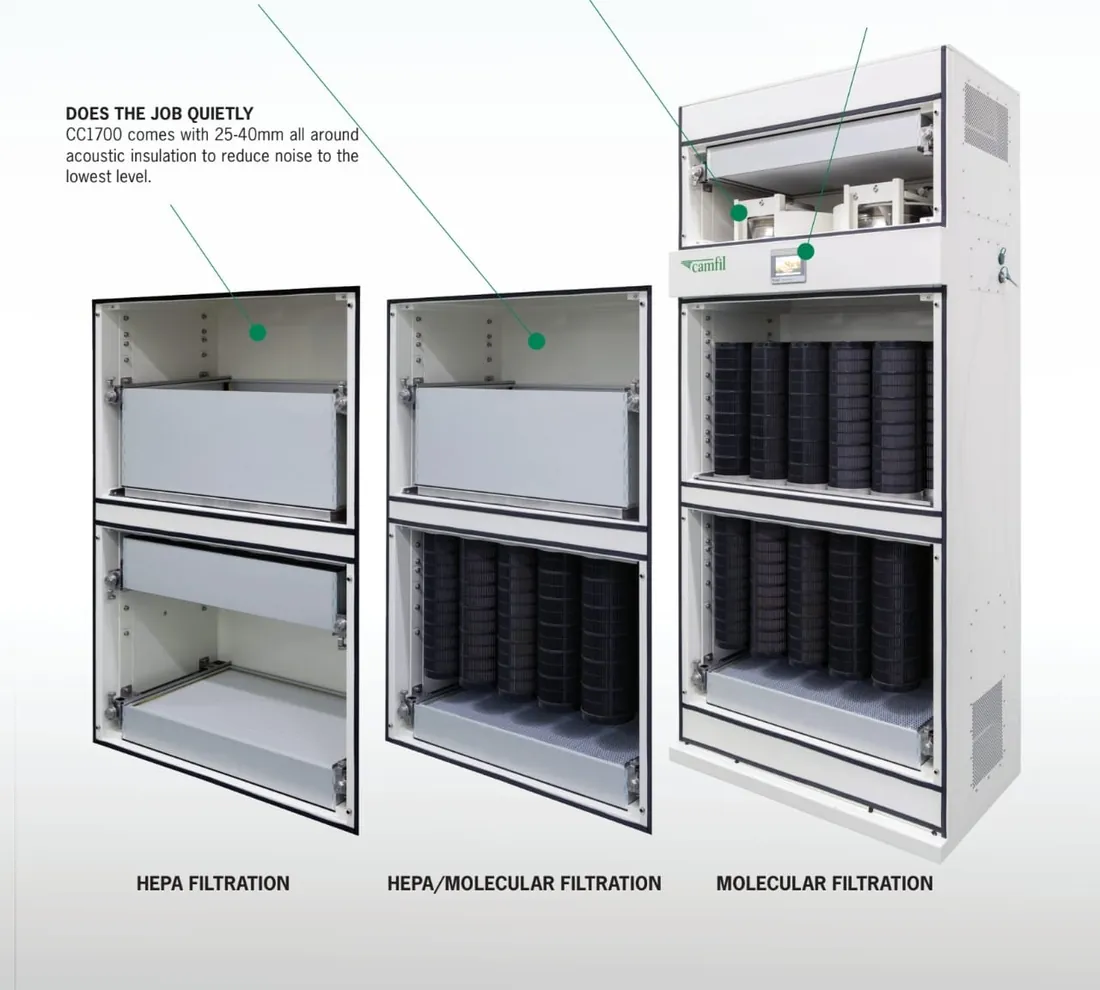
Filtration removes particles as air passes through filter media, usually inside a ventilation system or machinery intake. Purification is the broader goal of cleaning the air in a space, and can add stand-alone air cleaners and molecular filters. Particle filters do not capture gases and odours, so those need molecular media such as activated carbon.